
Westernization or Modernization?
How historical accident is still a pretext for repression

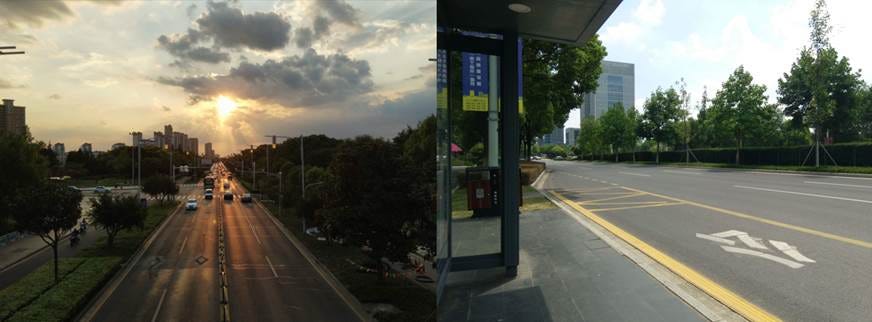
When I first arrived in China in 2018, I expected culture shock. But strangely, the most surprising thing was how familiar everything felt. The streets, cafés, traffic lights, and supermarkets felt instantly navigable, as if I had landed not in China but in an odd corner of the United States. Under this surface, differences of course remained: I needed to communicate in Mandarin, pay with WeChat, etc. But these contrasts were expected; the similarities were not.
This experience made me question what exactly I was experiencing. Were these signs of Westernization, the spread of Western modes of life, infrastructure, and economy into a quintessentially non-western country? Or were they instead simply a common end point that multiple societies might arrive at as they became wealthier and governance improved? In other words, where do we draw the line between Westernness on the one hand and Modernity on the other?
As outlined by Samuel Huntington in his seminal work “The Clash of Civilizations”, Western civilization is marked by its adherence to “liberalism, constitutionalism, human rights, equality, liberty, the rule of law, democracy, free markets, the separation of church and state”. Critically, however, these values are virtually unheard of before the late 18th century (see the afterword for a notable exception), until which point Western polities were often home to such systems as the divine right of kings, legally defined classes, royal absolutism, mercantilism, and state churches. By historical accident, the West was the first area of the world to reach an industrial modernity altered by the forces of the Enlightenment, Rationalism, and Scientific Revolutions, transformative movements of which the above “Western” values are only the incipient offspring. And yet, as Huntington shows, these very recent values are now the hallmarks of Western Civilization as European powers undertook their exploratory and imperialistic ambitions around the globe. Which features of modern western society are just modern, then, rather than truly western, and how can we untangle these two threads?
Maslow’s hierarchy of needs offers a useful sword for cutting the Gordian knot. According to Maslow, as societies secure material well-being such as food, housing, health, and physical security, they create the conditions for personal and social growth. Once basic needs are reliably met, citizens increasingly seek autonomy, self-expression, and participation in collective decision-making. The result is a gradual shift toward values often associated with the West: individualism, civic engagement, and demands for legal accountability.
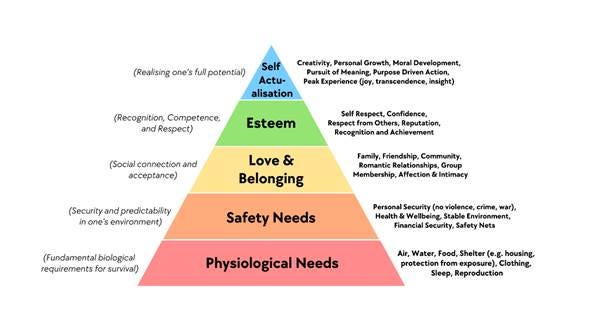
Crucially, the theory holds, this is not the product of cultural imitation. Rising expectations for liberty and equality can emerge in any society once material and educational thresholds are crossed. Economic development creates the conditions for these values, but does not impose a Western historical or philosophical framework. (The flipside to this is that what we think are culturally specific traits may be universals of the global poor lacking in education).
Western culture has historically coincided with these values, but it is not their origin. The reason is that the West was the first area of the world to begin a process of continuous economic development and growth, an event called the Great Divergence. Economic development, urbanization, and rising literacy produce demands for personal freedom, legal accountability, and political participation almost irrespective of historical cultural inheritance. When European powers constructed their global empires, they exported models of governance, commerce, and social organization to the territories they controlled. Yet the values they disseminated were rarely pre-modern philosophical or religious systems—Christian theology, Greco-Roman thought, or medieval legal codes—but rather the high-HDI, rationalist, industrialized, and bureaucratically organized systems that European societies had developed in the wake of the Enlightenment, Scientific Revolution, and early industrialization.
Yet radical post-colonial narratives, often employed by regimes seeking to maintain or impose authoritarian control, fail to make this distinction or often intentionally conflate these concepts. When young Iranians, Chinese or others clamor for more liberty and democracy, these demands are routinely dismissed as “Westernization” or, worse, “foreign agitation”. While Western inspiration can certainly be at play, These desires are also the predictable consequences of development, the inevitable impulses of citizens moving up Maslow’s hierarchy. The problem with all this is ultimately the confusion of correlation and causation; western culture is historically correlated with these values, but not causal of them. Radical post-colonial attitudes do not differentiate between what is western and what is development and moving up Maslow’s hierarchy.
By conflating Westernness with Modernity, societies and commentators alike risk misunderstanding both. Modern infrastructure, social mobility, and consumer culture may resemble Western forms, but they do not carry an inherent moral or political blueprint. Similarly, demands for equality, individual rights, or civic participation are not imports; they are expressions of human development in a globalized world. The challenge, then, is to recognize that the “West” is not a prerequisite for Modernity, nor is Modernity proof of Western influence. To do otherwise is to mistake the map for the territory, to read historical accident as causal law, and ultimately, to deny citizens the legitimacy of their own agency.
Afterword:
One area where a genuinely Western preference for equality emerges is in gender. Observers from the Muslim world repeatedly noted the striking freedoms European women enjoyed, even centuries ago. Usāma ibn Munqidh (d. 1188) recounted with shock in his Book of Contemplation that a European husband might allow his wife to speak privately with another man while he waited patiently—behavior unimaginable in many Muslim societies. Similarly, the Ottoman prince Jem, exiled in Europe in the late fifteenth century, found opportunities for casual romantic encounters with women he described as unveiled, socially accessible, and unrestrained by the strict seclusion expected back home.
These accounts illustrate a broader point: historical Europeans did in fact allow, in certain ways, greater gender autonomy than many contemporary, and even modern, societies. Are there other cultural norms that can be said to really predate the Great Divergence? In other words, what is Western and what is Modern?