
That Wasn’t Thunder
How a Childhood under Oklahoma Tornadoes Prepared me for Adulthood under Iranian Missiles

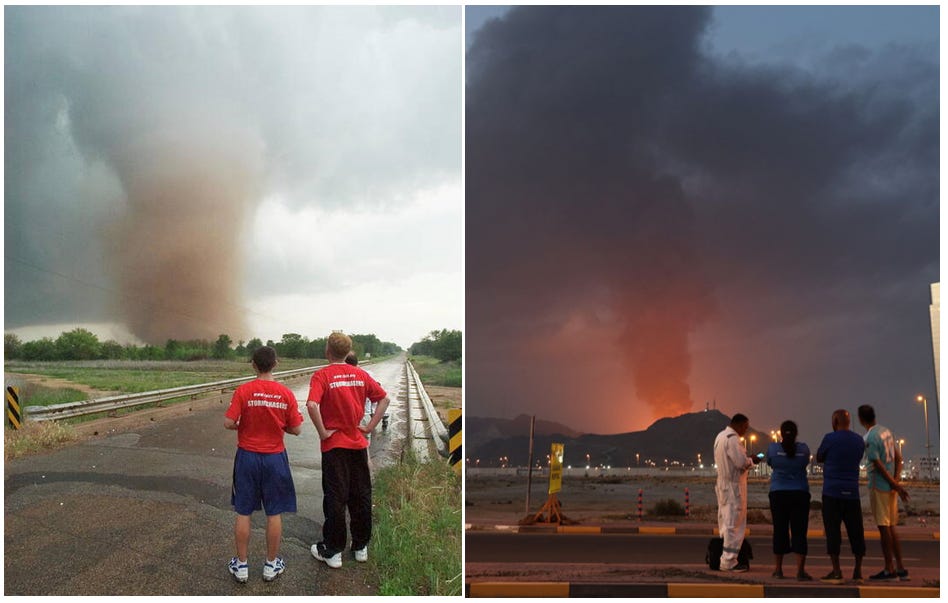
Watching Iranian missiles explode over my head in Abu Dhabi last month reminded me, strangely, of my upbringing in the American Midwest. One may wonder at the comparison, but I grew up in Moore, Oklahoma, the heart of Tornado Alley, dubiously dubbed “Tornado Town, USA” for regularly suffering the most destructive winds on the surface of the Earth. And while for many years living abroad I resented the provinciality of my native land, I can now, with the distance of many years and miles, look back on my upbringing with some degree of appreciation for how it equipped me for challenges I never imagined I would face.
After leaving Oklahoma at 29 years old and roaming with a hungry heart through China, France, and elsewhere, I find myself now a resident of Abu Dhabi, capital of the United Arab Emirates. In February my family and I fled from a day at the beach as we watched Iranian missiles being shot down above us. But as the initial shock transitioned into a daily routine of SMS alerts and cover drills as life continued more or less as normal, I slowly realized that my circumstances were eerily reminiscent of my upbringing. Some children in other parts of the world may grow up with church bells, clocktowers, or muezzins marking out the time; my equivalent was the test of tornado sirens every Saturday at noon, as the nearest alarms, all slightly out of tune, moaned together in a hauntingly beautiful chorus. From kindergarten I, like most Oklahoma schoolchildren, rehearsed for tornado drills by lying prone under my desk. Most evenings between April and June every year, our family dinners were spent watching a television tuned into a weather forecast, often punctuated by the grating emergency tone when the National Weather Service would issue a tornado warning. It is the same that I hear every day during the current conflict to signal an incoming volley of Iranian missiles.
In one of my earliest tornadic memories, one evening I found myself alone with my mother while my father worked late; tornado sirens incited us to take shelter, and my mother became flustered and then outright panicked. Even at a young age, my instincts took the opposite course, consoling her while we made a comfortable spot in my bedroom closet, the innermost spot of our home. I opened a couple of windows having heard that it could help alleviate pressure differences and prevent shattering (in Abu Dhabi, that same factoid arose in the first days of the conflict, and it remains as dangerously false for missiles as it is for tornadoes). And I ran to the pantry to grab a snack in case we were stuck under debris—returning with a jar of peanut butter. That evening the warnings passed without incident, as they would on most evenings, but these sounds, drills, and alerts became second nature to me, but soon they would take on visceral reality.
On May 3rd, 1999, I took a short car ride to baseball practice near my home, but I arrived to find my teammates and their parents staring up, crane-necked. I will never forget the sight of the sky that evening, cloven neatly between the deepest imperial blue to the east, and an ominous, charcoal tempest encroaching from the west. A skeptic will dismiss this as the wisdom of hindsight, but I hold that years of weather-watching encoded some instinctual awareness, and we could feel that this was no ordinary storm. The adults had heard the alerts on their radios and some of the more fashionable families received calls on their cell phones. Practice was cancelled, and my family fled to the city of Norman, 10 miles south. There my dad distracted us with a visit to Toys-R-Us while a nightmare devoured my hometown. The long day waned, the storm passed, and we returned, with great trepidation, to find our home untouched, though without power (I would later learn that the tornado passed one mile to the north). We ate dinner by candlelight—an amusing novelty for a naïve 10-year-old—while I played with my new toy and ran around outside with other neighborhood kids by moonlight. As far as I knew, everything was fine – better than fine, because word soon circulated that school was cancelled for the rest of the week. Little wonder, in retrospect.
I cannot recall whether my parents had to return to work the next day, but I know that at some point that week I ended up in the care of my grandmother who had not gotten the message about sheltering me from what was quickly identified as the most destructive tornado outbreak with the fastest winds ever recorded on Earth. She elected to go on what I now recognize was an obscene, voyeuristic sightseeing tour of the damage. Though my immediate surroundings and elementary-school friends were all spared, many of my later friends in middle school would tell me that they had lost their homes in the storm. Many of our usual stores and restaurants were reduced to rubble, and our church was smashed to splinters. What had days before been neighborhoods, homes, lives, were flattened into homogenous seas of rubble.
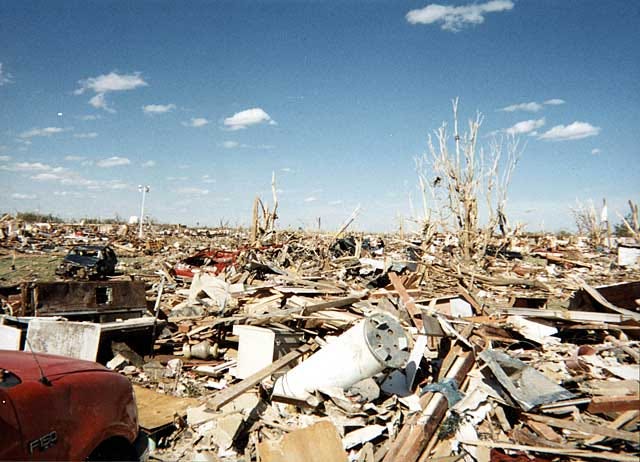
The “May 3rd tornadoes” passed into the record books, but the donations and reconstruction efforts that took place afterward brought the community together, even with such terrible losses, and life continued for those of us who remained. The sirens and drills continued, but in the windy Oklahoma plains our vigilance rusted, unburnished, over the following months and years. It is difficult to express the tangle of feelings, but these admittedly dangerous and horrible moments provided me with some strangely comforting ritual and tradition; in the atomized, socially disconnected world of the middle-American suburbs, weather-watching was a rare opportunity for social bonding, to step onto one’s front lawn and talk with one’s neighbors, swapping meteorological folk wisdom along with other news and gossip. For me now living on the other side of the world, the memory of those moments provokes a kind of morbid nostalgia.
It can be impossible to perceive the strangeness of our condition until we are confronted with someone from outside it. When I met my now-wife, Emmanuelle, at the University of Oklahoma in 2013, I realized how unusual the situation was seen through her French eyes. The fact that I kept a go-bag in the closet was for her a visceral shock of the reality of life in Tornado Alley. Her face would pale at the mention of a mere tornado watch, and she sought shelter in the university library basement at the declaration of a warning. What was a weekly occurrence for an Oklahoman was a rare, mortal danger for someone from a world away.
Nature humbles even Oklahomans, of course, and on May 20th of that year, another massive tornado outbreak struck even closer to home. I was living in Norman at that time, but my parents’ and grandmother’s houses were damaged, and my elementary school and my cousin’s house were stripped down to the foundations. We joined readily in the cleanup efforts that followed, and my wife developed a great sympathy for the voluntarism and community spirit she witnessed: people commuted from across the United States, and even from Canada and Mexico, to deliver help and succor. Together, she and I joined thousands of volunteers who cooked meals, dug through rubble, and rebuilt these shattered communities.
Nevertheless, our differing mentalities continued to shape our reactions to life’s challenges. In 2018 we relocated to China, and in January 2020 we left our apartment near Shanghai for a vacation in Tokyo just as a then-unnamed virus shut down the city of Wuhan. Emmanuelle was glued with horror to the Chinese infection stats page, while my Oklahoman disaster-honed mentality allowed me to focus on the immediate and continue to enjoy the luxury of my first visit to Japan. The birth of our first child later that year, and our second in 2023, have changed my mental state drastically, and as I find myself today, within drone range of Iran, bearing live witness to a major geopolitical event for the second time in my life, I feel that doing so as a father allows little room for the contemplative observation I employed in 2020. My home in Abu Dhabi is closer to war than I ever thought I would be, and certainly closer than I ever would have chosen to be with children. As we fled home from the beach that first day of the conflict, I will admit I feared Abu Dhabi would play victim to the same kind of attacks that plague Kyiv. We packed a go-bag, and of course I remembered the peanut butter.
Luckily, my worst fears did not materialize, and the situation settled for weeks into the familiar routine: an SMS alert, a few minutes sheltering in place, the all-clear, then a return to life as normal. Any Oklahoman would feel right at home. But the truly uncanny aspect of it all is that the SMS alert tone is the same standard emergency tone that I grew up hearing on the TV. For most people it provokes a trickle of adrenaline; for me it is the same, but alongside it is something else: the unbidden tickle of nostalgia, of familiarity, of home. Though the world may still turn on the whims of the few, the tensions in the Gulf seem to be calming, giving me the emotional space necessary to reflect and put these words to the page.
There are lessons in this for everyone, I think. After tornado outbreaks in Oklahoma, one inevitably hears commentators from the rest of the country asking why anyone would choose to live in a place where such things happen. There are certainly people now who look at the fact of Iranian missile strikes on Dubai or Abu Dhabi and pose the same question. One could easily ask the same of Floridians after a hurricane, Turks after an earthquake, Hawaiians after an eruption of Kilauea or Japanese after a tsunami. Many outside the US ask it of Americans after a school shooting. There are few places on this earth not subject to some kind of existential risk, manmade or natural, that would frighten someone else from living there. These cynics miss the human ability to swim in the chaotic churn of life, to factor in risk, to take on danger with a frolic welcome. “Ordinary,” writes Margaret Atwood in the Handmaid’s Tale, “is what you are used to.”
For many years I lamented that I was born and raised where I was, far removed from anything I deemed exotic or exciting. Only now, with the wisdom and perspective that life seldom confers on those of fewer years, do I understand what benefits I have reaped and to what privileges I am heir by dint of the fate and happenstance of my birth. And only now, too, do I begin to understand that these terms are matters of perspective, that anything can inspire wonder—or fear—in those who have never experienced it. But as the current conflict shows me, my upbringing imparted through disaster and tragedy a strange preparedness that sits at my very core. For many people the grating screech of an emergency alert provokes a trickle of adrenaline; for me the adrenaline flows adulterated with the unbidden tickle of nostalgia, of familiarity, of the warmth of humid spring evenings decades gone. And when I hear a boom, there is some deep part of me that does truly wonder if it is thunder.
NB: For full disclosure, my childhood home was in Oklahoma City about a quarter of a mile from the Moore city limits. I attended Moore schools, my family did our grocery shopping in Moore, and most of my young life centered around the parts of Moore and southwest Oklahoma City that tornadoes reduced to rubble—twice, in a little over 14 years.